Water damage restoration in Chattanooga runs $1,000–$8,000. Mold can establish on damp material within 24 to 48 hours, so drying is a race — and here ventilation often will not win it, because outdoor air in the wet season is frequently no drier than the air inside.
Why opening the windows is local bad advice, what gets dried versus replaced, and how to document a claim before anything is moved.
The advice that backfires here
Everyone’s instinct after a water event is to open the house up. That works where outdoor air is drier than indoor air. In this valley during the wet season it frequently is not — the rain arrives in the cold months, humid air settles into the valley and lingers, and the air you invite in may carry more moisture than the air you are trying to remove.
The reliable route is mechanical: containment, dehumidification, and directed air movement, with material moisture content measured rather than judged by touch. It is less satisfying than opening a window and it is the difference between drying a wall and replacing one.
What gets dried, what gets removed
| Material | Usual outcome | Why |
|---|---|---|
| Framing, subfloor, concrete | Dried in place | Non-porous or semi-porous; recover well if reached in time |
| Drywall, wet more than 48 hours | Removed to a line above the water | Porous; growth extends into it rather than sitting on it |
| Fiberglass and cellulose insulation | Removed | Loses performance and holds moisture against framing |
| Carpet pad | Removed | Effectively a sponge; carpet above may be salvageable |
| Cabinet toe kicks and bottom plates | Opened and read | Cavities hold water long after surfaces feel dry |
| Hardwood flooring | Depends on readings | Cupping can recover; sustained saturation usually cannot |
The first two hours are yours
- Stop the source if it is a supply line, and cut power to affected areas if water is near outlets
- Photograph everything before moving anything, with the date visible in the file
- Move contents up and off wet flooring rather than out through wet rooms
- Do not open windows during a wet-season event — check whether outdoor air is actually drier first
- Call the same day, because the clock started when the water did
The damage you cannot see
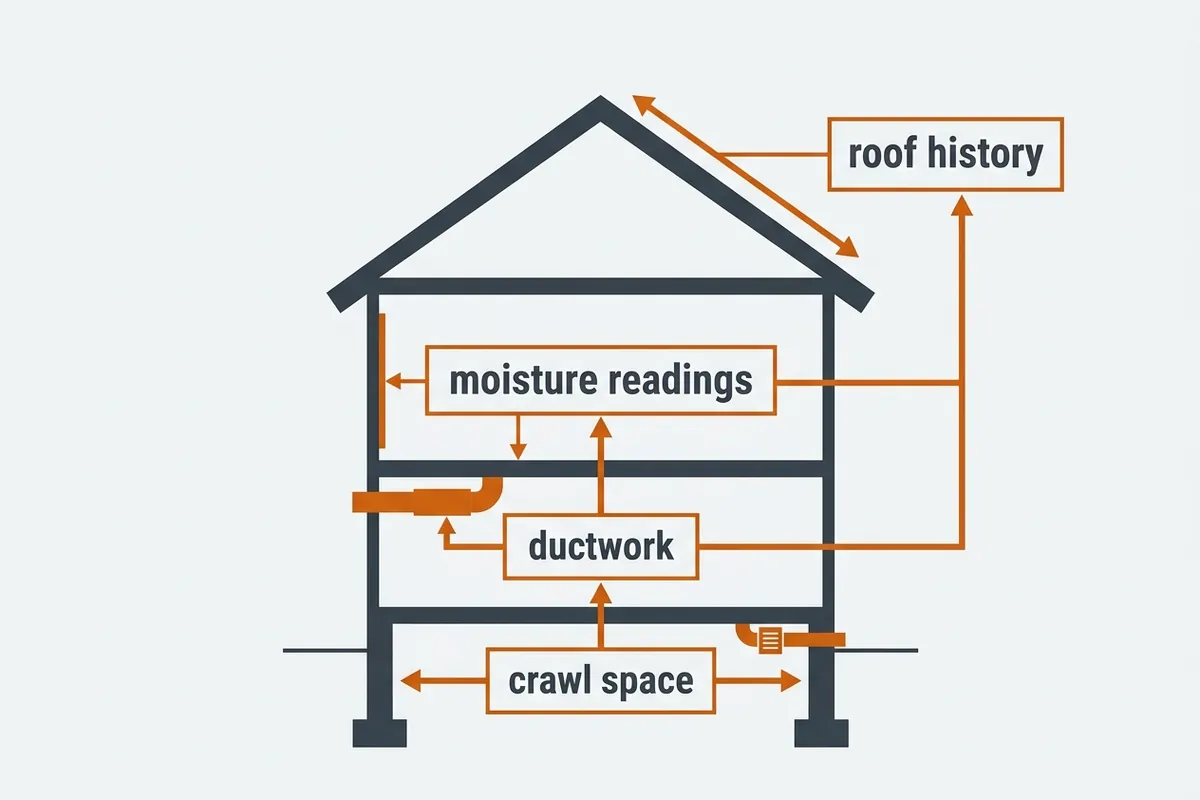
The risk after a storm breach is rarely the water on the floor. It is the water that ran inside a wall, soaked the bottom plate and the insulation, and is now behind finished drywall where nothing evaporates. A roof gets tarped, the ceiling stain stops spreading, everyone relaxes, and growth continues inside the assembly for months.
Cavities have to be read with a meter and opened where readings warrant. A good crew documents what was wet, what was dried, and to what moisture content — which is also what an adjuster needs, and what makes the difference if a claim gets argued. Costs are in the cost guide.
What homeowners ask after a water event
What does water damage restoration cost in Chattanooga?
Drying and restoration runs $1,000-$8,000 depending on how much material is wet, how deep the water travelled, and whether it reached cavities. Acting inside the first day or two keeps most jobs at the low end, because the difference between drying materials and replacing them is largely a question of timing.
How fast does mold start after water damage?
Growth can begin within 24 to 48 hours on damp organic material at normal indoor temperatures. That window is the entire reason emergency drying exists as a trade. Water that sits through a weekend before anyone acts turns a drying job into a removal job, at several times the cost.
Should I open the windows to dry things out?
Often not here, and this is the local trap. Ventilation only dries a space when the outdoor air is drier than the indoor air. During the wet season in this valley, outdoor air frequently is not, so opening the windows brings in moisture and slows the process. Mechanical drying with a dehumidifier is the reliable route.
Will insurance cover it?
Sudden and accidental discharge - a burst supply line, an appliance failure, a storm breach - is commonly covered, including reasonable drying. Long-term seepage and gradual leaks generally are not, and mold coverage often carries its own sublimit. Document the start with dated photographs before anything is moved.
What about water that came in through the roof during a storm?
Storm breaches are usually covered as sudden damage, and the risk is not the water you saw but the water in the cavity you did not. A tarp or a patch stops the leak without drying the wall behind it, and growth continues inside finished construction. Insist that cavities be read with a meter, not judged by appearance.
Get a Chattanooga mold inspection
Tell us what you are seeing or smelling — dark spots on a cold exterior wall, a musty smell in one room, condensation on a window frame that never dries, staining in a closet on the north side. A good visit includes surface temperature readings and a trip under the house. A local specialist who serves Chattanooga will call you back.